How to Get Your Brand Cited by AI Engines
Most brands have no idea what ChatGPT says about them — or why. The data-backed guide to AI search visibility: how citation works, which levers move it, and what our own numbers look like across 10 engines.
Most brands we audit have no idea what ChatGPT says about them. Some have never asked. Others asked once, received a vague response and moved on. Almost none track it systematically — across engines, across query types, over time.
That gap matters. AI search is not a fringe channel. Perplexity handles over 100 million weekly queries. Google AI Mode is now the primary interface for commercial searches across much of Europe. ChatGPT is the starting point for product and service research among under-45s in several categories. If you are invisible in these responses, you are losing buyers before they reach your website.
This post covers how AI engines decide who to cite, what the evidence says actually moves citation rates, and what our own visibility data looks like across 10 engines. Claire Enders, who leads AI visibility at pmax and works on the CrunchJunkie tracking product, wrote this from live data.
Why AI visibility is not SEO
The reflex is to treat AI search visibility as SEO in a new format. The two share some DNA — crawlability, structured data, content quality — but the mechanism is different enough that identical interventions produce very different outcomes.
Google Search ranks pages. It evaluates signals and returns a ranked list of links. Your job in SEO is to rank above competitors on that list. The user chooses from it.
AI engines synthesise answers. They draw from sources they consider credible and corroborated, construct a response in their own words, and surface a recommendation — often a short list, sometimes a single named brand. There is no ranked list. You are either in the response or you are not. If you are not, the user never sees a link to you.
A brand with strong domain authority and years of SEO investment can be completely absent from AI responses in its own category. We see this regularly. A smaller competitor with clear, specific, consistently corroborated content appears in every response. The difference is not SEO performance. It is entity clarity and citation readiness.
SEO still matters — it builds the technical foundation that AI crawlers need. But it is necessary, not sufficient. For a deeper look at what optimising for generative search involves, see our guide to generative engine optimisation.
How AI engines decide who to cite
The most useful research on this is Aggarwal et al. (KDD 2024), which measured what content characteristics actually improve AI citation rates. The paper tested nine optimisation strategies against a control. Two findings stand out.
Direct quotations in content improved citation rates by 27.8%. Cited statistics — specific, verifiable numbers in the body text — improved them by 25.9%. Authoritative external citations: +24.9%. Generic brand language produced no measurable effect.
The pattern is clear. AI engines prefer content that functions like evidence. Not marketing copy — referenced claims, specific numbers, verifiable facts. “pmax manages over €2 million in annual paid media spend across Google Ads and Meta” is citable. “We deliver exceptional results for ambitious brands” is not.
Three structural factors sit alongside content quality. First, AI crawlers need to reach your site. Approximately 13% of AI crawler fetches are blocked by web application firewall (WAF) rules written to block scraper traffic, without distinguishing between malicious bots and legitimate AI retrieval bots like OAI-SearchBot or PerplexityBot. If your WAF blocks these, your content is invisible regardless of its quality. Second, entity consistency: identical brand name, location, founding year and services across your site, Google Business Profile, LinkedIn and industry directories. Contradictory information introduces hallucination risk. Third, third-party coverage in sources AI engines already treat as authoritative — specialist publications, established review platforms, co-published case studies.
pmax’s visibility across 10 engines
We track our own AI visibility using CrunchJunkie — 35 prompts across 10 AI engines, running continuously. Over the 30 days to 7 September 2026, pmax was cited in 1,107 out of 3,198 total runs: a 34.6% overall citation rate.
Here is the engine-by-engine breakdown, alongside rex4media — our nearest tracked competitor. We lead the overall cited run count 2.4:1 (1,107 vs their 470 cited runs). Where rex4media’s bar turns amber, they beat us.
Source: CrunchJunkie AI Visibility tracking · 35 prompts · Sep 7, 2026 · crunchjunkie.io
Our strongest engine is GPT-4o Search at 51.4%. That reflects consistent presence in the sources ChatGPT’s retrieval layer pulls from: our blog, third-party directory listings, and owned social channels.
Google AI Mode (17.1%) and Claude (11.4%) are our weakest positions. Rex4media outperforms us on both — 34.3% and 22.9% respectively. The source pools these engines weight diverge from the ones that favour us on GPT-4o. That is where we are focusing remediation work now.
The 2.4:1 overall lead should not create false comfort. Engine mix matters as much as aggregate citation rate. If Google AI Mode becomes the dominant commercial search surface in Europe — and the trajectory points that way — our underperformance there is the more consequential number.
The seven levers that move the needle
Based on the GEO research and what we have observed in our own tracking data, these are the interventions that produce measurable citation rate improvement.
1. Specific, quotable content. Replace generic brand claims with exact, verifiable facts. Your about page and service descriptions should read more like a Wikipedia entry than a brochure. “pmax is a performance marketing agency in Calvià, Mallorca, founded in 2023” is citable. “We deliver exceptional results for ambitious brands” is not.
2. Cited statistics. Back every significant claim with a number. Not “most advertisers” — “13% of AI crawler fetches are blocked by WAF rules by default.” Cited statistics improve citation rates by 25.9% in the KDD 2024 research. Use them throughout your highest-traffic pages.
3. FAQ content. AI engines regularly synthesise question-and-answer content because it maps directly to how people query them. Every service page should have a structured FAQ section covering the genuine questions your buyers ask. Pair it with FAQPage schema.
4. AI crawler access. Audit robots.txt and — more importantly — your WAF configuration. OAI-SearchBot, PerplexityBot, Claude-SearchBot, ChatGPT-User and Google-Extended should not be blocked. One client we audited had all five inadvertently blocked via a Cloudflare bot management rule. We unblocked them; citation visibility improved within 30 days.
5. Entity consistency. Brand name, founding year, team, location and services should be identical across every channel. Contradictory information across platforms — different founding years, different service descriptions — introduces hallucination risk and reduces AI confidence in your entity data.
6. Third-party coverage. A single mention in a respected industry publication does more for citation rates than ten self-published posts. AI engines weight sources they already trust. Digital PR, podcast appearances and co-published client case studies all build the third-party corroboration that underpins long-term citation rates.
7. Owned off-site channels. YouTube, LinkedIn, Substack — content on your owned channels outside your main domain is tracked and cited separately. CrunchJunkie’s off-site citation data shows which channels each engine draws from per topic cluster, and where you have gaps. That maps directly to content investment decisions.
None of these levers produce immediate results. They compound over months. Our own trajectory — from no tracking to a 97/100 GEO audit score and 1,107 cited runs in 30 days — took roughly nine months of consistent work across all seven dimensions.
What a technical GEO audit checks
A GEO audit is the structured diagnostic for the access and content factors above. The one we run through our AI visibility service covers five categories, each weighted by how much evidence supports its impact on citation rates.
AI crawler access (30/100). Can retrieval bots reach your key pages? Robots.txt review, WAF and bot management rule audit, and live crawl verification using user-agent strings from OAI-SearchBot, PerplexityBot and Claude-SearchBot. The 13% block rate is real and usually the highest-impact fix.
Content accessibility (30/100). Is critical content server-rendered? JavaScript-dependent content is often invisible to AI crawlers that do not execute JS. If your service descriptions load via a React component that requires browser rendering, they may not be in the crawlable DOM at all.
Structured data (20/100). JSON-LD quality and coverage: Organisation or LocalBusiness, Service, FAQPage, Person for named team members. Schema helps AI engines resolve your brand as a defined entity with consistent attributes.
Technical SEO hygiene (15/100). Canonical tags, sitemap currency, title and description lengths. Foundation work that prevents crawl issues from undermining otherwise solid content.
llms.txt (5/100). Weighted at 5 of 100 deliberately. Google confirmed in August 2026 that Google Search ignores llms.txt. Approximately 97% of published llms.txt files receive zero AI crawler requests. Worth having; not a priority. Our pmax.online GEO audit score is 97/100 — CrunchJunkie’s “AI-ready” band.
How to track your own AI visibility
Manual tracking — running prompts yourself across ChatGPT, Perplexity, Claude and Gemini — is where every AI visibility programme starts. The limitation is variance. AI responses are non-deterministic: run the same prompt twice and you can get different brands, different framing, different citation lists. A single query is a data point, not a trend.
To track AI visibility with statistical meaning you need three things.
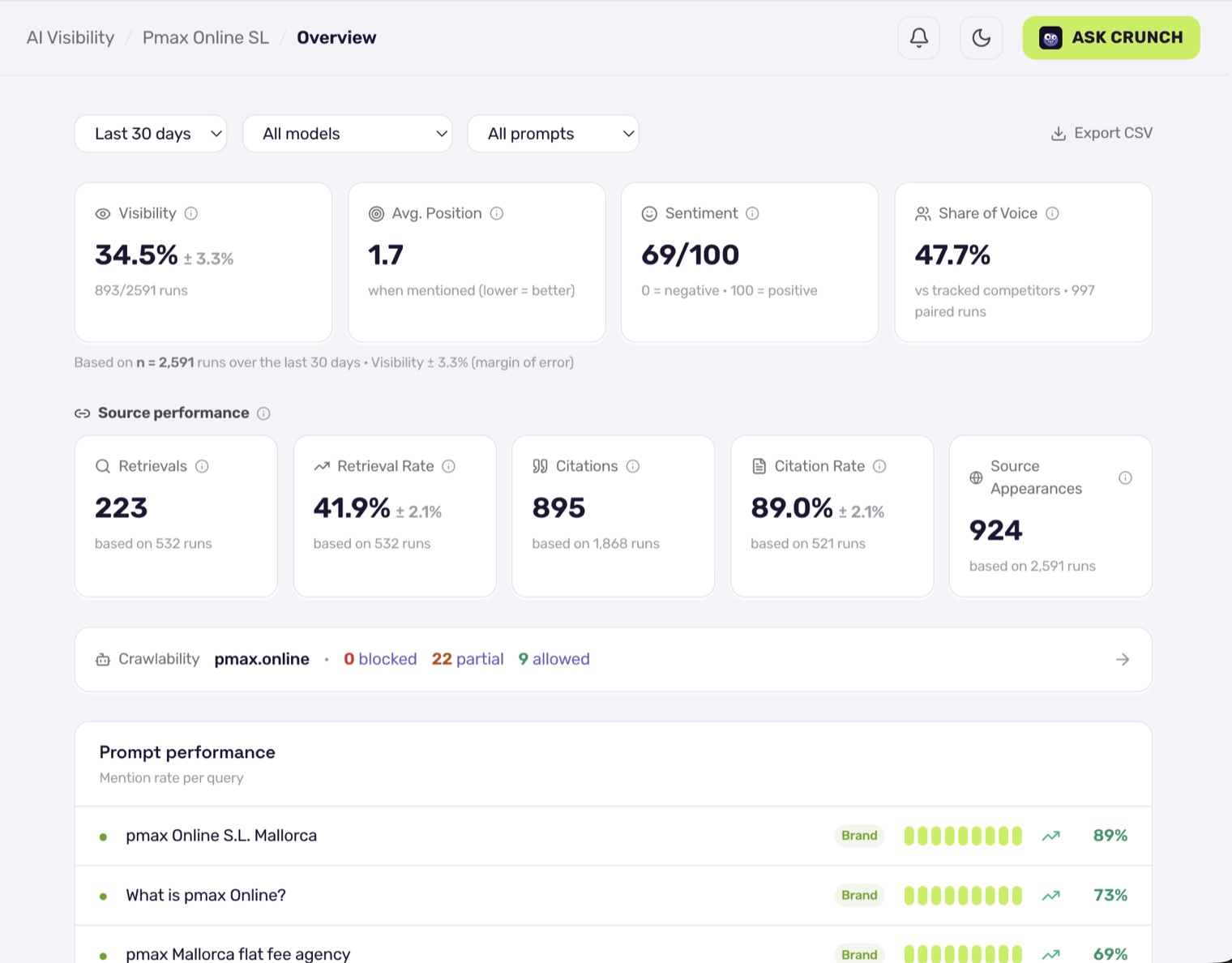
Multiple runs per prompt. Fifteen to twenty minimum to produce a citation rate with a reliable margin of error. The difference between “34.5% ± 3.3% based on 2,591 runs” and “34.5%” is the difference between a measurement and a number. The former tells you whether a four-point drop is a real signal or noise. The latter does not.
Coverage across engines. Each engine has distinct citation behaviour. GPT-4o and Perplexity cite aggressively from crawled web content. Google AI Mode draws heavily from the Google index and Knowledge Graph. Claude weights authoritative sources differently. Tracking only ChatGPT gives you a partial picture of a fragmented market.
Trend data over time. A one-off audit tells you where you stand today. Systematic tracking over weeks and months tells you whether your interventions are actually working — and whether a competitor is gaining ground on engines where you are weak.
We use CrunchJunkie for this work: all 35 prompts, all 10 engines, continuous tracking with margin-of-error reporting and competitive benchmarking against rex4media and others. Our AI visibility service includes tracking setup, a full GEO audit and a monthly reporting cadence. For a breakdown of what to look for in an AI visibility tracking tool before you pay for one, see our buyer’s guide to AI visibility tracking tools.
Need help with this?
If any of the above feels like a problem you have, tell us a bit about your situation and we will come back within a working day. First conversation is 30 minutes, on us.
Common questions
What is AI search visibility and how is it measured?
AI search visibility is the percentage of AI-generated responses, for a defined set of queries, in which your brand is cited or recommended. It is measured by running each tracked prompt multiple times across target engines — ChatGPT, Perplexity, Claude, Gemini and others — recording which brands appear, and calculating a citation rate with a margin of error. Fifteen to twenty runs per prompt is the minimum for a statistically meaningful reading.
How do I get my business mentioned by ChatGPT?
The evidence-backed levers are: specific, quotable content with verifiable facts and cited statistics; FAQ content mapping to how people query AI engines; AI crawler access (WAF rules audited for OAI-SearchBot and PerplexityBot); consistent entity data across all channels; and third-party coverage in sources AI engines already trust. Generic brand language has no measurable effect on citation rates. The KDD 2024 GEO study found cited statistics improved citation rates by 25.9% and direct quotations by 27.8%.
What is a GEO audit and why does it matter?
A GEO audit is a structured diagnostic of how ready your website is to be crawled and cited by AI search engines. It covers five categories weighted by evidence strength: AI crawler access (30/100), content accessibility (30/100), structured data (20/100), technical SEO hygiene (15/100), and llms.txt (5/100). It tells you where your citation readiness is weakest and what to fix first.
How is AI visibility different from traditional SEO?
SEO optimises for ranked position in a list of links. AI visibility determines whether your brand appears in a synthesised answer — often a short list of recommended brands or a single named option. There is no ranked list for the user to scroll; you are either in the response or not. A brand with strong SEO can be entirely absent from AI responses if it lacks the specific, quotable content and third-party corroboration that AI engines use to decide who to cite.
Which AI engines should I focus on for brand visibility?
Track all the major engines — citation behaviour differs significantly between them. Our own data shows a 51.4% citation rate on GPT-4o Search but only 11.4% on Claude — same brand, same prompts, very different outcomes. If you track only one engine you are measuring a fraction of an increasingly fragmented market.
Claire is a digital marketing strategist at pmax, a performance marketing and AI visibility agency in Calvià, Mallorca. She leads content strategy and AI search optimisation for pmax clients, and contributes research on GEO and AI brand visibility. She also works on CrunchJunkie, an AI visibility tracking platform for monitoring brand citation across ChatGPT, Perplexity, Claude, Gemini and six other engines.
LinkedIn →