What Is Generative Engine Optimisation (GEO)?
GEO is not SEO with a new name. It is a different discipline built for AI-generated answers — and research shows specific techniques can boost your citation rate by up to 40%. This is the complete guide, including an 8-step implementation framework.
When you type a question into ChatGPT or Perplexity, you do not get ten blue links. You get a direct answer. That answer draws from sources — some named, some not. The websites cited are not necessarily the ones ranked on page one of Google. They are the ones easiest for AI systems to read, extract from, and trust.
That is the heart of Generative Engine Optimisation. GEO is the practice of making your content more citable in AI-generated responses. It is not a rebranding of SEO. It is a different discipline built for a different kind of search.
This guide covers what GEO is, how it differs from traditional SEO, what peer-reviewed research shows about which interventions actually work, and the 8-step framework we use with clients. We also share our own numbers — because at pmax, we apply everything in this guide to our own website first.
GEO is not SEO with a new name
Traditional SEO is built around one mechanism: ranking in a list. Google scores your page, assigns it a relevance position, and shows it to users. Success is measured by position — first, second, tenth.
GEO operates on a completely different mechanism. There is no list. An AI engine synthesises a single answer from multiple sources. Whether your content contributes to that answer depends not on ranking position but on whether the AI can extract, trust, and attribute what you have written.
SEO rewards inbound links, domain authority, and page speed. GEO rewards cited statistics, direct expert quotations, and structured, extractable content. SEO optimises for position. GEO optimises for inclusion.
These are not the same discipline. They share some inputs — a technically sound, fast website helps both. But the specific interventions that move the needle are different enough that treating GEO as “SEO with AI keywords” produces poor results.
A page that ranks number one on Google may never appear in a Perplexity answer. A page outside the top 100 on Google may be cited by ChatGPT in response to every relevant query. We have seen both. The gap between those outcomes is almost entirely technical and structural — not a question of who has the better product.
pmax estimates, based on current trajectory and observed traffic data, that AI engines will handle 30% of search queries by 2027. Building visibility now costs significantly less than catching up in two years against brands that already have citation history with AI systems.
What the research shows
The foundational academic paper on GEO was published at KDD 2024 by Aggarwal et al.: “GEO: Generative Engine Optimization.” It is the most rigorous study to date of what actually moves citation rates in AI-generated responses.
The headline finding: “GEO can boost source visibility by up to 40% in AI-generated responses through optimisation methods including citations, statistics, and quotations.”
Three specific techniques produced the largest measurable improvements:
- Adding cited statistics to content: +25.9% citation rate
- Including direct expert quotations: +27.8% citation rate
- Improving content fluency: +15.9% citation rate
A 27.8% improvement in citation rate from adding direct quotations is not a marginal adjustment. It is also one of the simplest changes to make. The paper also found that authority signals — framing content with references to named sources, institutions, and published research — performed consistently well across all AI engines tested.
What does not move the needle: keyword density, meta description length, internal link count. The inputs SEO has trained most marketers to optimise for are, at best, neutral for GEO. At worst, focusing on them distracts from the interventions that actually work.
The techniques that most improve AI citability require genuine expertise. Cited statistics and direct expert quotations cannot be fabricated. GEO rewards substance — not SEO-optimised structure. In practice, that is a quality filter on what AI search surfaces.
How AI engines decide what to cite
AI engines draw from two sources: training data (content the model was trained on before its knowledge cutoff) and live web retrieval (pages fetched in real time for a given query).
Live retrieval is where GEO has its most immediate impact. When ChatGPT, Perplexity, or Gemini retrieves live results, it runs crawlers to fetch pages relevant to a query, extracts the most citable passages, and synthesises them into a response.
For your page to be cited, three conditions must hold:
- The AI crawler must reach your page — no robots.txt blocks, no WAF rules blocking GPTBot, ClaudeBot, or PerplexityBot
- The content must be server-rendered — AI crawlers generally do not execute JavaScript
- The content must contain attributable, quotable claims — statistics with named sources, direct quotes, structured extractable data
If any of those conditions fails, the page is excluded regardless of other optimisations.
The third condition is the most commonly missed. Most pages are full of unattributable claims: “We are leaders in our field.” “Best-in-class service.” These cannot be extracted, verified, or attributed. They contribute nothing to an AI response.
Replace them with: “According to the Balearic Islands Tourism Institute, German tourists spend an average of €1,200 per trip in Mallorca.” That is attributable. That is citable. That is GEO.
The 8-step GEO framework
This is the implementation checklist we work through on every client site. In order of priority:
- Ensure AI crawler access. Check your robots.txt for blanket blocks (
User-agent: *combined withDisallow: /). Check your WAF for rules that block GPTBot, ClaudeBot, or PerplexityBot by user-agent string. AI crawlers announce themselves — if you are blocking them, even unintentionally, you are invisible to AI search regardless of everything else. - Server-render your content. AI crawlers do not execute JavaScript. If your key pages are rendered client-side — React SPAs without SSR, heavy client-side frameworks — AI systems cannot read them. The fix: server-side rendering or static generation for all content-bearing pages.
- Add cited statistics to every key page. Every major claim needs a named source. “Research by Aggarwal et al. found a 25.9% improvement in AI citation rates from cited statistics.” “German tourists spend an average of €1,200 per trip in Mallorca, according to Balearic Islands tourism statistics.” Named, attributed statistics are the single highest-value GEO intervention.
- Add direct expert quotations. Pull quotes from named individuals — your team, industry experts, clients with consent. “Claire Enders, performance strategist at pmax: ‘Most websites are invisible to AI engines not because of poor content, but because of how that content is structured.’” That is citable. A page full of “we believe” is not.
- Structure content with extractable lists and tables. AI models prefer to extract structured content — numbered lists, comparison tables, step-by-step processes. Prose-only pages are harder to synthesise from. Every major concept should have a structured companion: a table, a numbered list, or a clear definition block.
- Implement FAQPage JSON-LD schema on Q&A content. FAQPage structured data is already used by Google for featured snippets. AI engines use the same signals. Every page with a Q&A section — service pages, blog posts, resource pages — should carry FAQPage schema.
- Create an llms.txt file. An emerging standard, analogous to robots.txt, that provides AI crawlers with guidance about your site’s content, key pages, and preferred summaries. It lives at your domain root. Not yet universally adopted — but adoption is growing fast. Creating one now is a low-cost bet on a standard that looks increasingly inevitable. See our GEO audit guide for implementation detail.
- Monitor your AI visibility. Track which engines cite you, at what rate, in response to which prompts, and how sentiment tracks over time. Without measurement you are operating blind. We use CrunchJunkie to track pmax.online across 10 AI engines and 35 configured prompts. See our AI visibility service for how we extend this to clients.
How to measure GEO progress
AI visibility measurement is still maturing. The tools are improving fast, but buyers need to understand what they are actually measuring before committing to a platform.
The core metrics to track:
| Metric | What it measures |
|---|---|
| Citation rate | Percentage of AI responses in which your content or brand is cited |
| Share of voice | How often you are cited relative to named competitors |
| Average position | Where you appear in responses that do cite you |
| Sentiment | How AI engines describe you — positive, neutral, or hedged |
Measurement requires running the same prompts repeatedly across multiple AI engines. A single run is not statistically meaningful. We benchmark on 35 prompts across 10 engines, with automated weekly scans.
One practical constraint worth naming: most AI visibility tools meter by prompt quota, which creates an incentive to track fewer queries than you should. We covered this in depth in our AI visibility tracking tools guide.
The sister post to this one approaches AI search visibility from the German-market perspective: KI-Sichtbarkeit und AI Visibility.
What we do at pmax
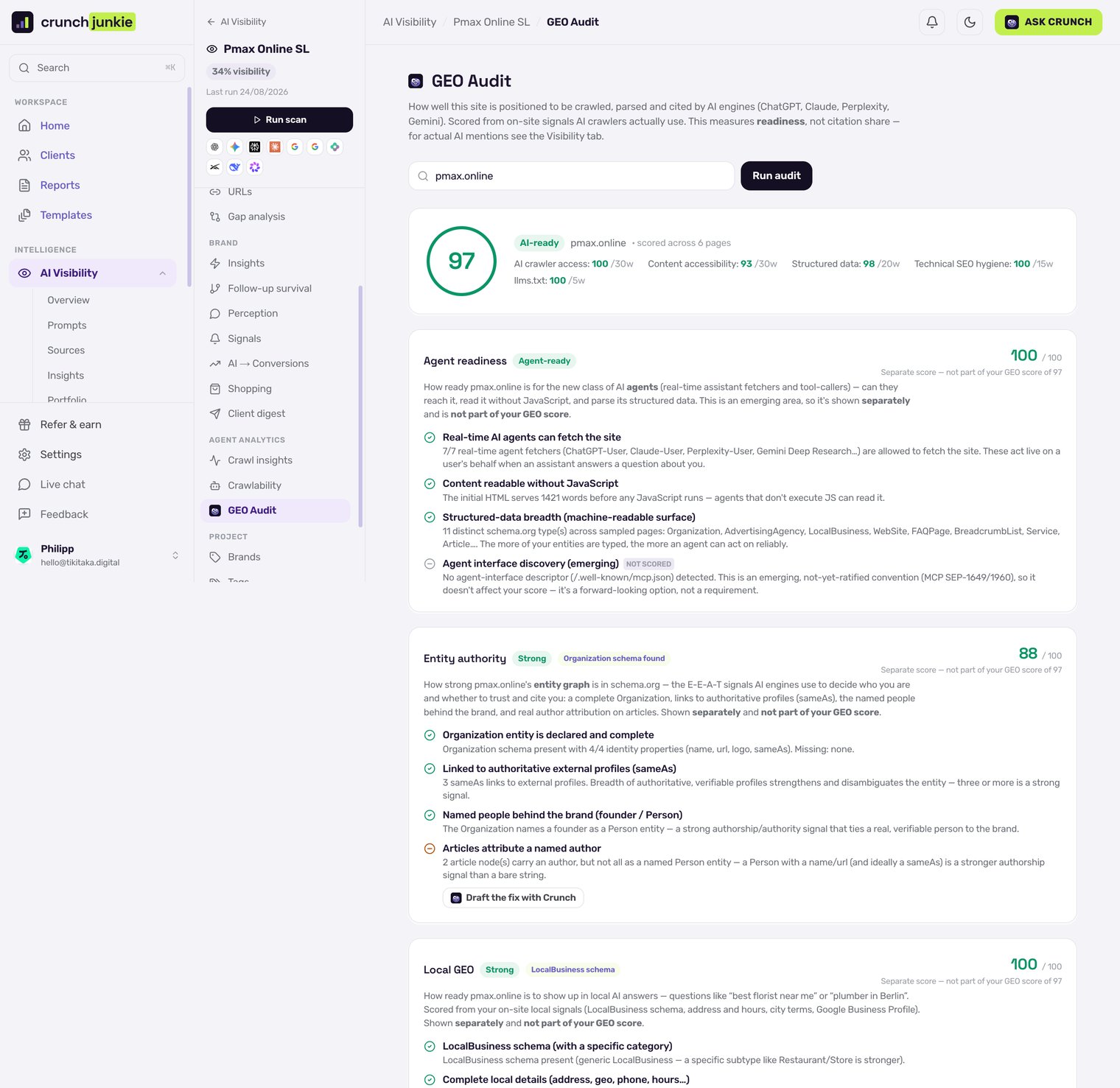
We track pmax.online across 10 AI engines — ChatGPT, Gemini, Perplexity, Claude, Google AI Overviews, Google AI Mode, Microsoft Copilot, Grok, Meta AI, and DeepSeek — using 35 configured prompts via CrunchJunkie. Current numbers, September 2026:
| Metric | Value |
|---|---|
| GEO audit score | 97 / 100 |
| Band | AI-ready |
| Cited runs — last 30 days | 1,107 |
| Engines monitored | 10 |
| Prompts tracked | 35 |
The framework in this post is what we used to get there. None of it is proprietary. The gap between brands that appear in AI responses and those that do not is almost always technical and structural.
We offer AI visibility tracking and optimisation as a service — monitoring, interpretation, and the optimisation work that follows from the data. If you want to know where your business currently stands, a GEO audit is the right starting point.
Need help with this?
If any of the above feels like a problem you have, tell us a bit about your situation and we will come back within a working day. First conversation is 30 minutes, on us.
Common questions
What is Generative Engine Optimisation (GEO)?
Generative Engine Optimisation (GEO) is the practice of optimising website content to be more frequently cited in AI-generated search responses — from engines like ChatGPT, Perplexity, and Gemini. Unlike traditional SEO, which optimises for ranking position in a list of results, GEO optimises for inclusion in a synthesised answer. The key interventions are different: cited statistics, direct expert quotations, server-rendered content, and AI crawler access rather than link-building and keyword density.
How is GEO different from SEO?
SEO optimises for ranking in a list of search results. GEO optimises for inclusion in a synthesised AI-generated answer — there is no list, only inclusion or exclusion. SEO rewards inbound links, domain authority, and keyword alignment. GEO rewards cited statistics, direct expert quotations, extractable structured content, and technical crawler accessibility. Some inputs overlap — a fast, well-structured site helps both — but the specific interventions that move citation rates are different.
How do I optimise my website for ChatGPT and Perplexity?
Start with technical fundamentals: ensure GPTBot and PerplexityBot are not blocked in your robots.txt or WAF, and that your pages are server-rendered rather than JavaScript-only. Then address content: add cited statistics with named sources to every key page, include direct expert quotations, structure content with numbered lists and comparison tables, and implement FAQPage JSON-LD schema. Finally, create an llms.txt file and begin monitoring your citation rate across engines.
What is the most effective GEO technique according to research?
Aggarwal et al. (2024), published at KDD '24, found that adding direct expert quotations improved AI citation rates by 27.8% — the single largest uplift of any technique tested. Adding cited statistics improved citation rates by 25.9%. Both outperformed authority framing, keyword optimisation, and fluency improvements.
How do I know if my website is being cited by AI engines?
You need an AI visibility tracking tool that runs configured prompts across multiple AI engines and measures whether your brand or content appears in the responses. We use CrunchJunkie, which tracks 10 engines — ChatGPT, Gemini, Perplexity, Claude, Google AI Overviews, Google AI Mode, Microsoft Copilot, Grok, Meta AI, and DeepSeek — with automated weekly scans and statistical confidence intervals on each metric.
What is an llms.txt file?
An llms.txt file is an emerging standard, analogous to robots.txt, that provides guidance to AI crawlers about your website's content, key pages, and preferred summaries. It lives at the root of your domain. Not yet universally adopted by all AI engines, but support is growing fast. Creating one now costs almost nothing and signals to AI crawlers that your site is prepared for AI indexing.
Claire is a digital marketing strategist at pmax, a performance marketing and AI visibility agency in Calvià, Mallorca. She leads content strategy and AI search optimisation for pmax clients, and contributes research on GEO and AI brand visibility. She also works on CrunchJunkie, an AI visibility tracking platform for monitoring brand citation across ChatGPT, Perplexity, Claude, Gemini and six other engines.
LinkedIn →